[Event Report]The 12th Quantum Solid Flagship Seminar

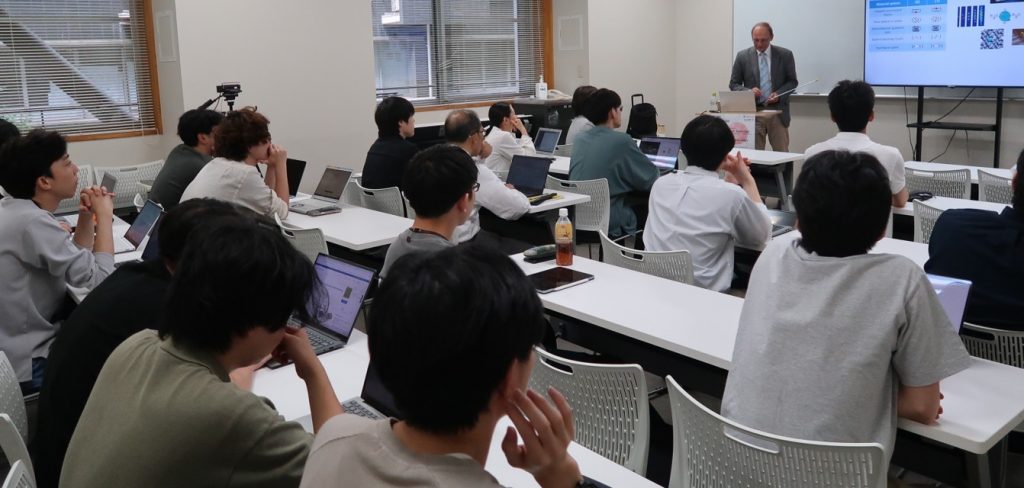
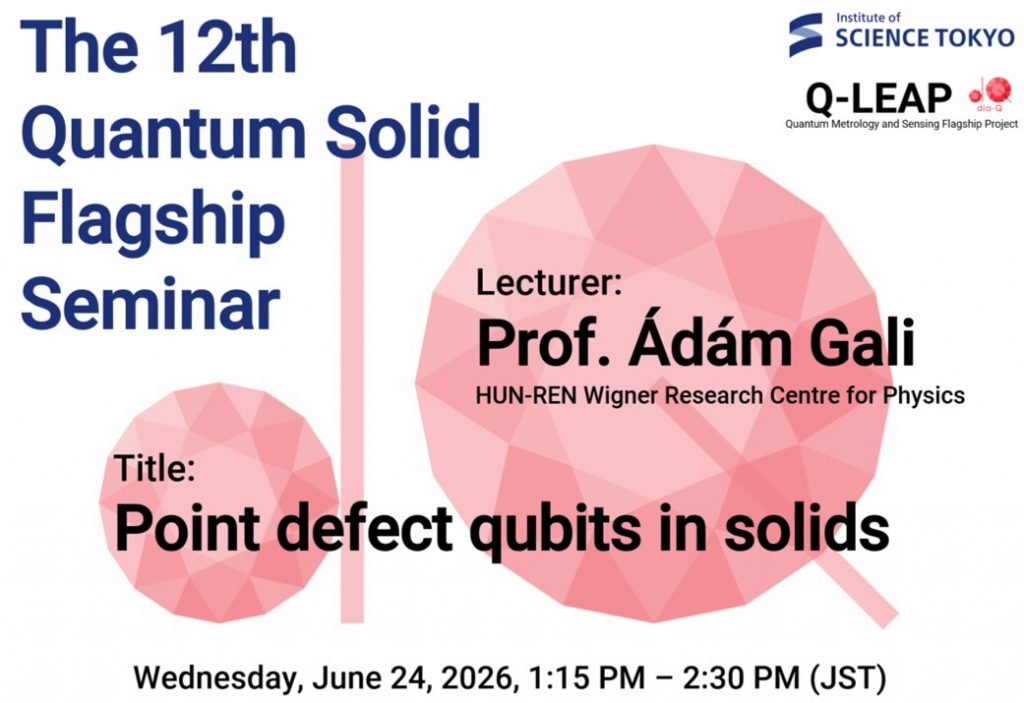
On June 24, 2026, we hosted the 12th Q-LEAP Quantum Solid Flagship Seminar. We were honored to welcome Prof. Adam Gali, a leading researcher in quantum technology using point defects in solids, who delivered a lecture titled “Point defect qubits in solids.” The seminar was a great success, with over 70 participants in total, including approximately 20 attendees on-site and 50 joining online.
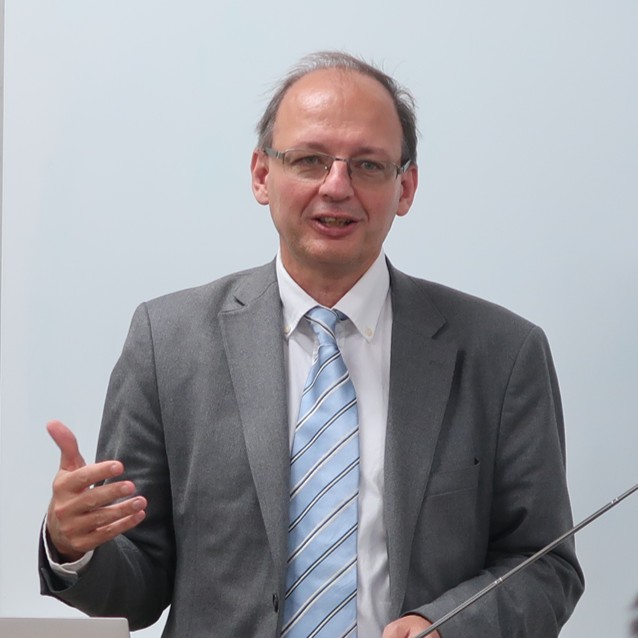
Prof. Gali provided a comprehensive overview of the potential of point defects in solids as quantum bits (qubits), covering everything from fundamental principles to cutting-edge applications.
The lecture began by clarifying the physical distinctions between classical bits and qubits, followed by a discussion on why point defects in solids are excellent candidates for quantum information processing. Using the nitrogen-vacancy (NV) center in diamond as a model case, Prof. Gali detailed the feasibility of room-temperature operation, the structure of the spin Hamiltonian, and the mechanisms of optical spin polarization and readout.
From a theoretical physics perspective, he demonstrated how group theory is used to analyze selection rules. He also elucidated the critical role of the pseudo-Jahn-Teller effect and electron-phonon interactions in enabling forbidden transitions.
In the latter half of the lecture, Prof. Gali addressed the challenge of performance degradation near the surface of NV centers and proposed silicon carbide (SiC) as a promising alternative material. He presented his latest research findings showing that terminating the SiC surface with alkane chains suppresses the influence of surface defects, allowing for stable quantum properties even at depths of just a few nanometers from the surface—a topic that drew significant interest from the audience.
Finally, he discussed the synergistic relationship between academia and industry, noting that research in quantum technology drives improvements in material quality, which in turn contributes to the development of classical device industries, such as power electronics.
Following the lecture, there was a lively Q&A session with active participation regarding theoretical backgrounds and experimental methodologies. The discussion was particularly fruitful, covering topics such as the identification of oxygen vacancy defects in SiC and technical approaches to controlling spin state lifetimes.
This seminar provided a valuable opportunity to gain a bird’s-eye view of solid-state quantum technology, from fundamental theory to device applications, offering insights that will serve as a guide for future research for many of the participating researchers and students.